Azure VMware Solution Licensing Changes: VCF BYOL, Broadcom Deadlines, Costs, and Compliance Risks
Executive Summary
Azure VMware Solution (AVS) remains available from a technology and service-offering perspective, but Broadcom’s licensing changes are making the commercial model significantly more restrictive for customers. Previously, customers could acquire VMware Cloud Foundation (VCF) licensing directly through Microsoft as part of their AVS deployment, simplifying procurement and eliminating the need for a separate VMware/Broadcom licensing agreement.
Broadcom has now effectively closed that path as well. Microsoft is retiring the AVS SKUs that include VCF licensing, forcing customers toward portable VCF subscriptions that must be purchased separately from Broadcom or its authorized channel partners. The result is additional procurement complexity, greater dependency on Broadcom’s licensing model, and potentially less commercial flexibility for customers that previously relied on Microsoft as the single contracting vehicle for AVS.
Under the BYOL model, Microsoft continues to operate the AVS platform, while customers must purchase VCF, register their license details in Azure, and ensure deployed BYOL cores remain aligned with their Broadcom entitlements.
Two separate deadlines require immediate attention depending on the customer’s current AVS licensing model:
-
October 31, 2026 – License-Included PayGo: Customers using license-included Pay-As-You-Go (PayGo) deployments must transition to the portable VCF (BYOL) licensing model by this date.
-
August 30, 2027 – License-Included Reserved Instances: Customers with existing license-included Reserved Instances (RIs) may continue using them until their reservation expires or August 30, 2027, whichever comes first. After that, they must transition to portable VCF (BYOL) licensing or move their workloads off AVS.
What Changed & Why It Matters
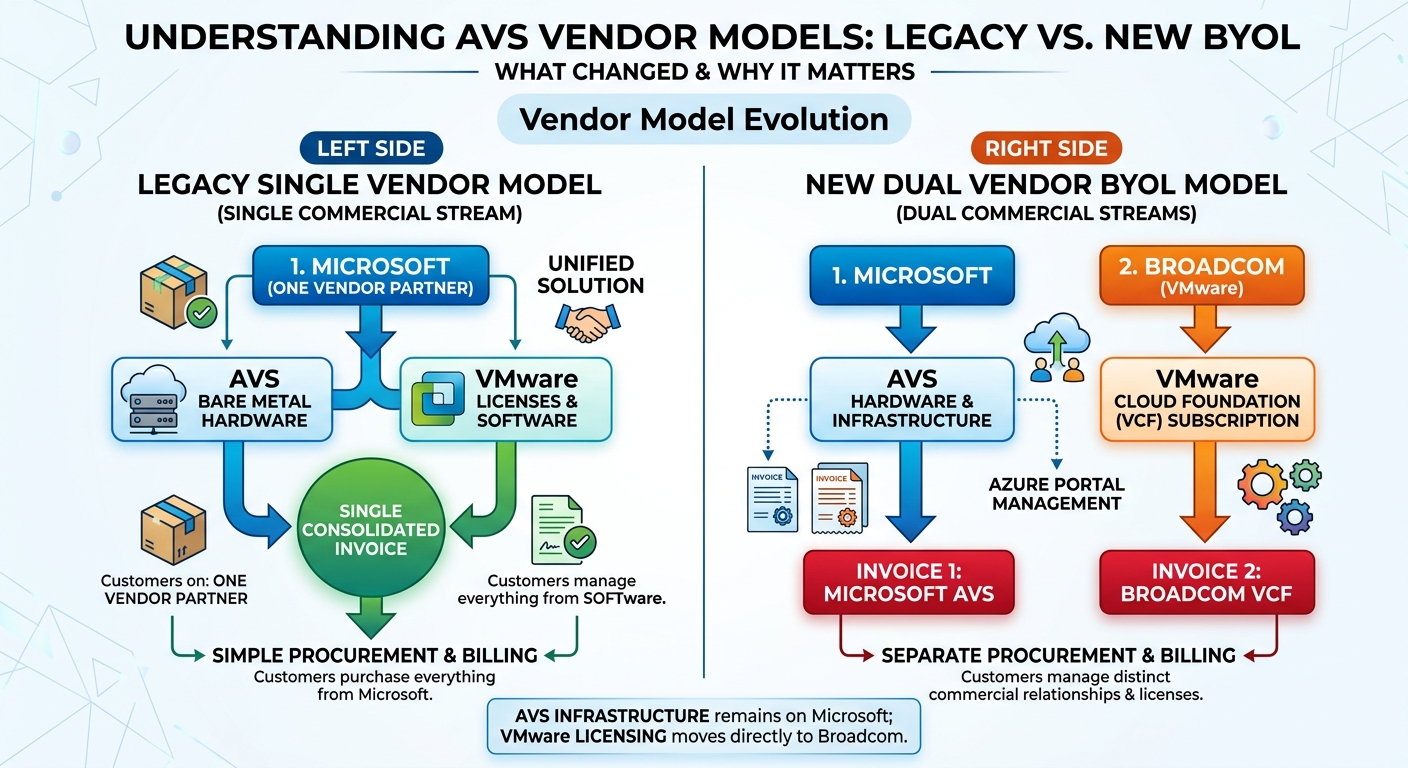
Microsoft continues to fully manage AVS infrastructure and SDDC components (ESXi, vCenter, NSX upgrades/patches), but software licensing is now unbundled. Customers manage two separate commercial components: AVS infrastructure billed by Microsoft, and portable VCF subscriptions purchased separately from Broadcom or its channel ecosystem.
Key Transition Timeline & Cutoff Milestones
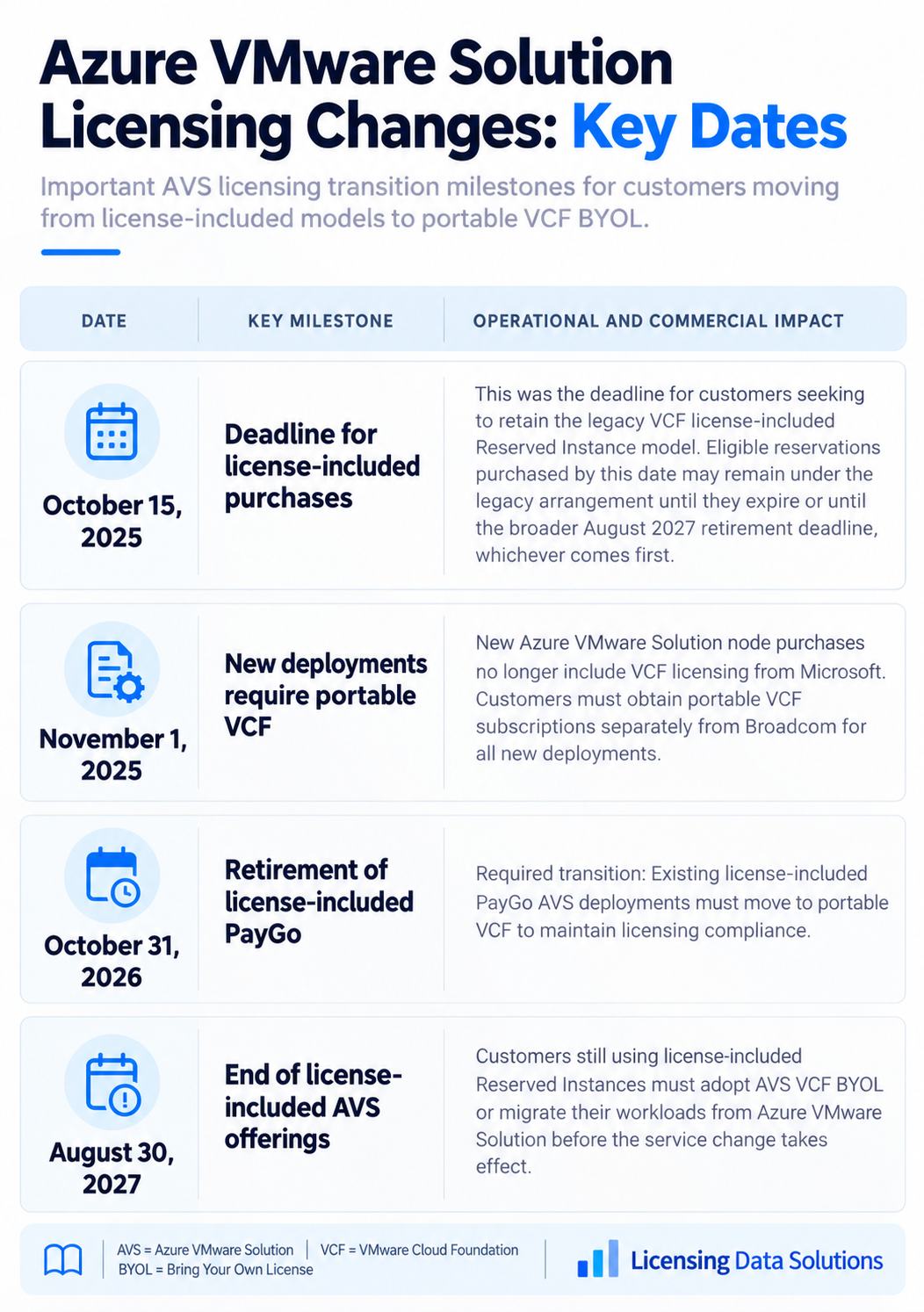
| Date | Key Milestone | Operational and Commercial Impact |
| October 15, 2025 | Deadline for license-included purchases | This was the deadline for customers seeking to retain the legacy VCF license-included Reserved Instance model. Eligible reservations purchased by this date may remain under the legacy arrangement until they expire or until the broader August 2027 retirement deadline, whichever comes first. |
| November 1, 2025 | New deployments require portable VCF | New Azure VMware Solution node purchases no longer include VCF licensing from Microsoft. Customers must obtain portable VCF subscriptions separately from Broadcom for all new deployments. |
| October 31, 2026 | Retirement of license-included PayGo | Required transition Existing license-included PayGo AVS deployments must move to portable VCF to maintain licensing compliance. |
| August 30, 2027 | End of license-included AVS offerings | Customers still using license-included Reserved Instances must adopt AVS VCF BYOL or migrate their workloads from Azure VMware Solution before the service change takes effect. |
https://learn.microsoft.com/en-us/azure/azure-vmware/license-included-service-retirement
Recommendations for Azure VMware Solution Customers
-
Perform a VMware/Broadcom License Position Assessment.
Before transitioning to Broadcom-purchased VCF subscriptions, customers should establish a clear understanding of the VMware footprint currently deployed within Azure VMware Solution. Broadcom’s licensing model includes core-based licensing, minimum requirements, bundled products, and strict compliance obligations. Customers should consider engaging an independent licensing specialist such as Licensing Data Solutions to validate deployment counts, determine the appropriate VCF quantity, identify compliance exposure, and estimate the financial impact of moving from Microsoft-provided licensing to a Broadcom or channel agreement. -
Build the transition plan well ahead of the retirement dates.
License-included PayGo AVS deployments must transition to portable VCF by October 31, 2026, while remaining license-included Reserved Instance deployments must transition by August 30, 2027. Customers should avoid waiting until the final months, particularly because Broadcom procurement, contract negotiations, reservation exchanges, and technical registration can take time. -
Model the full financial impact before signing with Broadcom.
Do not evaluate only the VCF subscription price. Model total cost across VCF licenses, Azure AVS infrastructure, Reserved Instances, support, vDefend Firewall, future expansion, and any migration or modernization costs. This will help determine whether remaining on AVS is economically preferable to Azure-native alternatives or another private-cloud platform. -
Validate VCF core requirements before every AVS expansion.
Customers are responsible for ensuring that the number of registered portable VCF cores does not exceed their Broadcom entitlement. Azure host types carry fixed core counts—for example, AV36 has 36 cores and AV64 has 64 cores—so even a small infrastructure expansion can create a material licensing requirement. -
Establish an ongoing compliance control.
Treat portable VCF licensing as an actively managed entitlement, not a one-time purchase. Track VCF keys, subscription expiration dates, licensed cores, registered cores by private cloud, new host additions, and changes to firewall usage. Microsoft explicitly states that customers are responsible for keeping AVS registrations aligned with their Broadcom entitlements. -
Review vDefend Firewall separately.
Customers using NSX Distributed Firewall or Gateway Firewall functionality should confirm whether additional vDefend licensing is required. Microsoft notes that firewall usage above grandfathered entitlements can require a separate Broadcom vDefend subscription, and an improperly licensed private cloud can become noncompliant. -
Maintain licensing headroom, but avoid unnecessary overbuying.
Customers should maintain enough VCF capacity to support planned AVS growth, but should not purchase excessive cores simply to create a large compliance buffer. Forecast likely host additions and negotiate expansion pricing in advance. -
Negotiate Strong Commercial Protections in the Broadcom Agreement.
Customers should avoid accepting Broadcom’s standard commercial terms without negotiating protections that reduce long-term cost and licensing risk. Key provisions should include:-
3%–5% Renewal Price Caps: Establish a contractual annual cap on renewal increases.
-
Fixed Expansion Pricing: Pre-negotiate per-core pricing for incremental capacity.
-
Aligned Contract Terms: Coordinate Broadcom subscription dates with Azure Reserved Instance exchange and renewal dates.
-
License Portability Rights: Preserve the ability to move portable VCF licenses between qualifying on-premises and supported cloud environments.
-
True-Down Rights: Seek the ability to reduce committed quantities as workloads migrate away from VMware.
-
Audit Protections: Negotiate reasonable audit notice periods, defined audit scope, confidentiality requirements, cure periods, and restrictions on repeated or overly broad audits.
-
Price Protection for Future Growth: Lock in discount levels or unit pricing for anticipated VCF expansion during the agreement term.
-
Termination and Migration Rights: Where possible, negotiate flexibility if the customer exits AVS or materially reduces its VMware footprint.
-
-
Evaluate an AVS exit or modernization strategy in parallel.
Customers should not automatically assume that purchasing Broadcom VCF and remaining on AVS is the best long-term answer. Microsoft itself points customers toward alternatives including Azure-native infrastructure, Azure Red Hat OpenShift, and Nutanix Cloud Clusters on Azure. Customers should compare the multi-year cost and operational impact of staying on VMware with a phased migration away from VMware dependency. -
Use the licensing transition as negotiation leverage.
Customers being forced from Microsoft-included VMware licensing into a direct Broadcom commercial relationship should treat this as a new procurement event rather than simply accepting a replacement subscription. Competition, workload portability, cloud modernization, and potential VMware exit plans can all be used as leverage when negotiating price and contractual protections with Broadcom.
Final Takeaway
The shift to portable VCF licensing changes AVS from a relatively straightforward Microsoft-managed commercial model into a more complex two-party licensing structure involving both Microsoft and Broadcom. For SAM, procurement, and IT leaders, this is not simply a licensing administration change—it has direct implications for cost, compliance, contract risk, infrastructure planning, and long-term cloud strategy.
Customers should use the transition window to understand their current VMware footprint, validate the exact VCF core requirement, model the full financial impact, negotiate stronger contractual protections, and determine whether remaining on AVS is still the right long-term strategy.
The biggest risk is waiting until a renewal, expansion, or retirement deadline forces a decision. By then, customers may have significantly less negotiating leverage.
Need Help Navigating the AVS and Broadcom Transition?
Licensing Data Solutions helps organizations independently assess their VMware and Broadcom licensing position, calculate VCF requirements, identify compliance and over-licensing risk, model future costs, and prepare for negotiations with Broadcom and its channel partners.
If your organization is running Azure VMware Solution and needs to determine how many VCF licenses you actually need, what the transition is likely to cost, and what protections should be negotiated before signing a Broadcom agreement, we can help.
Contact Mark Thaver, Licensing Data Solutions at This email address is being protected from spambots. You need JavaScript enabled to view it. to discuss an independent AVS and VMware/Broadcom licensing assessment.
Know your position before Broadcom defines it for you.